
Build a daily writing habit, quietly.
The hardest part of a daily writing habit is not the words, it is sitting down.
The blank page, the voice insisting it has to be good, the week that slips by without a single line: writers know this loop well. Unlooped counts every day you show up, even for a hundred words, and keeps the whole record where only you can see it.

How Unlooped helps
Count the days you showed up
A writing day is any day you sat down, whether that produced a chapter or a hundred words. Unlooped adds it to your counter either way.
Streaks for sitting down
Your streak grows because you kept the appointment, not because you hit a word count, and milestones mark the weeks and months as they stack up.
Protect a writing window
Set a gentle reminder for your morning pages or your lunch-hour session, and keep today's status in view with a home screen widget.
A coach for the blank page
When resistance is winning, talk it through with an AI coach that runs entirely on your phone. Nobody else reads a word of it.
Showing up small: why a hundred words counts
The most common way a daily writing habit dies is by being too ambitious on day one. A thousand words feels wonderful on Sunday and impossible by Wednesday, and after the target is missed twice the whole project quietly folds. The fix is to set the bar almost embarrassingly low: a hundred words, one paragraph, ten minutes with the document open. A target that small is winnable on your worst day, and your worst days are the ones that decide whether the habit survives. What you produce matters less than the fact that you produced, because a habit is wired in through repetition, not volume. Show up small enough, often enough, and sitting down to write stops being a decision at all.
Unlooped is built around that logic. You are not logging word counts; you are logging days you showed up. Each session adds a day to your counter, your streak grows because you sat down, and milestones mark the first week, the first month, the first hundred days. On a rough Tuesday, a hundred reluctant words earn the same check mark as a three-thousand-word sprint, and over months that even-handed counting is exactly what keeps the chair occupied. The app never grades the writing, because it never sees the writing. It only keeps score of the one thing you fully control: whether you showed up today.
Perfectionism and resistance are the real blockers
Very few stalled writing habits stall for lack of ideas. The real obstacles are perfectionism, which judges every sentence before it is finished, and resistance, which shows up as suddenly urgent dishes, one more article to read, or a strong need to reorganize your notes app. Both feed the same loop: the page feels like a test, the test feels threatening, and avoiding it brings relief that makes tomorrow's avoidance more likely. The way out is to separate drafting from judging. Today's job is to put words down; some other day's job is to decide whether they are any good. Giving yourself explicit permission to write badly sounds like lowering standards, but it is really just moving the editing to where it belongs, after the draft exists.
Tracking supports this because it changes what counts as success. The goal stops being write something good, which you cannot fully control, and becomes sit down and write, which you can. In Unlooped the session is the win, so a clumsy page and a brilliant one look identical in your log. And when resistance takes a round and a day slips past, nothing you built is erased: progress is milestone-based, your history stays whole, and a missed day is a data point to notice, not a verdict on you as a writer. If you want backup on the hard days, the optional on-device AI coach is there to talk through the spiral before it eats the evening.
Morning pages and the fixed writing window
Deciding when to write is its own daily drain, and a habit that requires a fresh decision every day loses eventually. The strongest writing routines remove the choice. Morning pages are the classic version: a few pages written first thing, before email, before the inner critic is fully awake, with no requirement that any of it be usable. The other reliable shape is a fixed window, the same twenty or thirty minutes tied to the same anchor every day, with coffee, on the train, after the kids are down. In both cases the time and place become the cue, and the cue does the heavy lifting. You no longer negotiate with yourself about whether today counts; you just keep the appointment.
Unlooped is good at guarding a window like that. A gentle reminder nudges you when your slot opens, a home screen widget keeps today's status one glance away, and you can mark the session done from your Apple Watch without breaking stride. Because logging takes seconds, the app never competes with the writing itself; it simply closes the loop after you show up. Over a few weeks the reminder starts to feel less like an alarm and more like a standing meeting with the page, and the counter underneath it quietly records how many times you have kept it.
The compound effect of daily pages
Daily writing compounds in a way that is nearly impossible to feel in the moment. Two hundred words is one long paragraph, a modest ask by any standard, yet kept up every day it becomes roughly six thousand words a month and the raw material of a book-length draft inside a year. That part is just arithmetic. The deeper compounding is in the writer: starts get faster, sentences arrive with less strain, and ideas begin showing up during the day because they finally have somewhere to go. Slowly the identity shifts too, from someone who wants to write to someone who writes, and that shift is what makes year two easier than month two.
Because compounding is invisible day to day, you need a record to believe it, and that is what your Unlooped log becomes. The counter climbs, milestones land at the first month and beyond, and the shape of your practice fills in where you can actually see it. On a discouraged evening, sixty logged sessions are a harder argument to dismiss than a feeling. Missed days along the way change none of it: your history stays intact, the milestones you reached stay reached, and the log keeps telling the true story, which is that you keep coming back. Months of small pages, honestly counted, are how a body of work gets written.
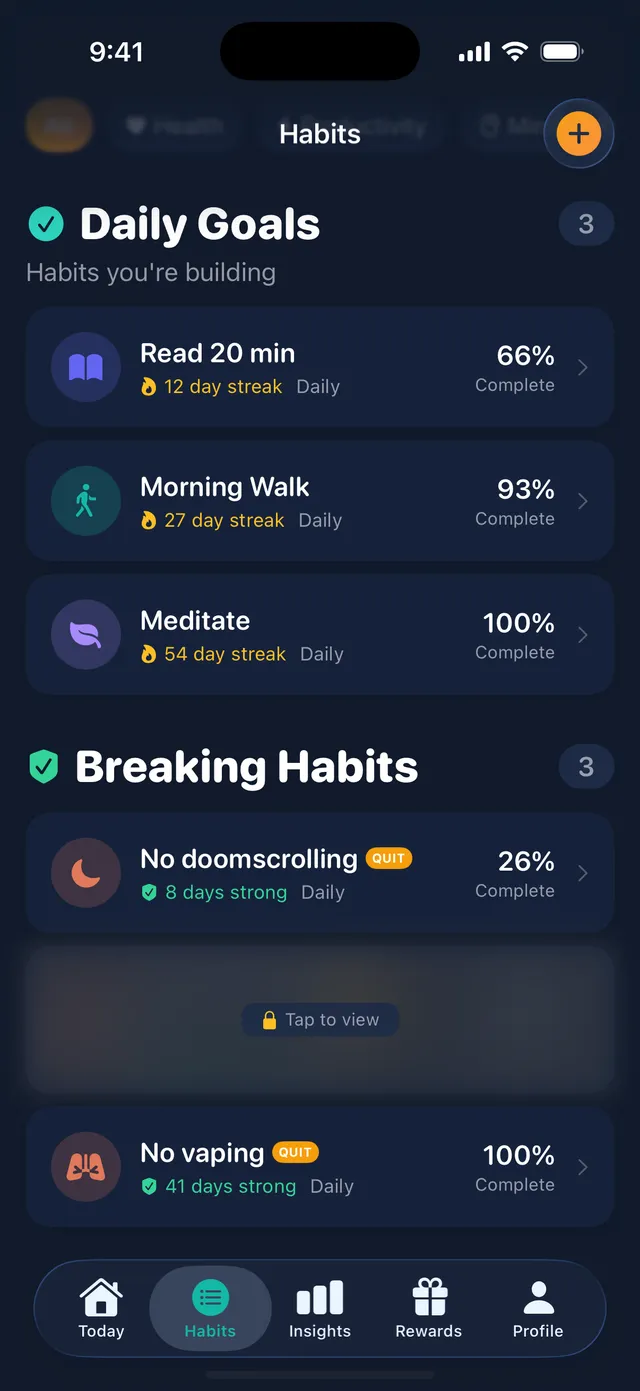
Your progress stays yours.
First drafts are private by nature, and your writing log should be too. Unlooped never asks for your pages; what it holds is the record of your practice: the days you sat down, your streaks and milestones, any notes you add, and every chat with the on-device coach. All of it lives on your iPhone. There is no account to create and no server that receives your history, so no copy of your practice exists anywhere we could read it. Syncing is optional and uses private iCloud sync, moving data between your own devices and nowhere else. Add a Face ID lock and the habit stays out of sight even on an unlocked phone.
Writing: frequently asked questions
Related guides
Practical, judgment-free reading on writing and the habits around it.
Best habit tracker for writers
Building a daily writing habit is hard. Most habit trackers make it harder by turning your progress into a performance metric that punishes you for...
How to build a daily writing habit
Writing daily sounds simple until you try it. Here's why it's genuinely hard, and what actually works.
Start today, privately.
Download Unlooped and take control of your writing journey.